Explainer
Evolution First Person vs Live Casino: What GO LIVE Changes
The short answer
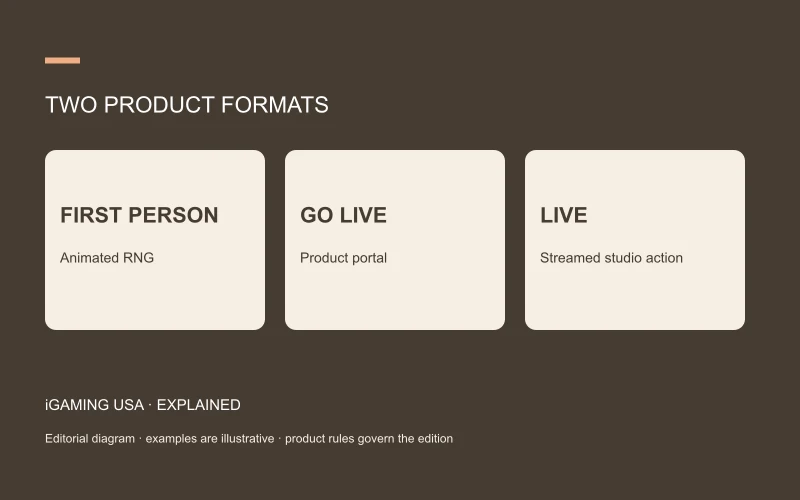
Evolution First Person games use animated, RNG-based gameplay. Their GO LIVE button connects to a corresponding live casino game, where a real studio supplies the streamed action. The connection makes these two formats a useful example of how one supplier builds a journey across different product types.
In this article
The format changes at the portal
Evolution’s product overview describes 3D animated games with a consistent interface and rules when moving to the live format. The First Person version lets the player initiate its action; the live version follows activity at the streamed table.
| Product layer | First Person | Live casino |
|---|---|---|
| Presentation | Animated environment | Stream from a physical studio |
| Round action | RNG-based game | Action supplied by the live table |
| Connection | GO LIVE portal | Corresponding live product |
For a reader comparing two lobby tiles, those three fields provide a useful starting point. Copy the full title from each tile, then identify the format inside its information panel.
Why familiar controls are useful
A consistent layout gives the reader recognizable places to find the bet, rules and recent result. The product can therefore introduce a new presentation format while retaining familiar controls. This is an interface observation based on the published design, rather than a measured claim about conversion.
Imagine a product walkthrough with four events: open the animated title, read its information panel, select GO LIVE and arrive at the live table. Record the title at each end and the time of transition. The resulting note documents the journey precisely.
A worksheet for an editorial or product review
Use six fields: full game title, supplier, format, table or game identifier, rules version and review date. Add the destination title when a portal is present. If the article concerns a US offering, include the state and the operator edition actually examined.
This structure makes a review reusable. A future editor can open the same title and compare the same fields, rather than interpreting a screenshot without its product context. It also gives readers a clear answer when similar artwork appears in several parts of a lobby.
What the connection means for a content catalog
One game family can contain more than one deliverable product. Cataloging the animated and live entries separately preserves their format, identifiers and operational context. Grouping them under the shared family name then explains the relationship between them.
What should a US reader verify?
Open the local operator’s edition and read its title, rules and available destination. Evolution’s international portfolio establishes the product concept; the particular local catalog establishes the offering being viewed. Our software platform guide explains where supplier content sits in the wider delivery chain, while Playtech’s dedicated studios offers a concrete example of live production.