Explainer
Bragg Fuze Integration: The A, B and C Building Blocks
The short answer
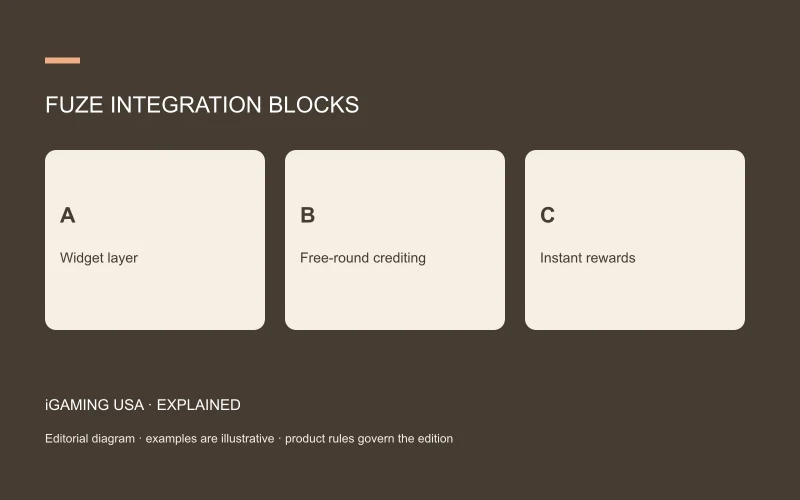
Bragg describes Fuze integration using three building blocks: A for the in-game widget, B for free-round crediting, and C for instant rewards. The framework is useful because it turns a broad engagement product into specific components an operator and its technology team can discuss.
In this article
A is the visible in-game layer
The official integration guide identifies an always-visible overlay within the game window and direct game switching through widget tiles. This is the interface foundation that presents the promotional tools.
For an editorial walkthrough, record the widget’s location, the labels it displays and the destination reached by each tile. Those observations describe what a user can see. The crediting workflow belongs in a separate record, because it concerns how a reward reaches an account.
B describes free-round crediting
Bragg divides B into B1, with manual batch uploads, and B2, with automated crediting. This gives a concrete way to discuss operational readiness. A team can name which crediting process a campaign uses and document the corresponding steps.
| Block | Published function | Useful project record |
|---|---|---|
| A | Widget and game-switch interface | Screen and destination map |
| B1 | Manual batch free rounds | Batch reference and processing time |
| B2 | Automated free rounds | Event and crediting reference |
| C | Instant rewards | Reward and balance reference |
The last column is a suggested worksheet from this publication. It gives each product component a documentable output.
C covers instant rewards
The guide associates C with real-money prizes, Flash Jackpots and immediate crediting to balances. When explaining a campaign, describe the qualifying event, the reward unit and the account record together. This makes the journey understandable from the user’s action through to the recorded reward.
Imagine a hypothetical test campaign with 20 eligible accounts and one free-round allocation per account. The project worksheet would contain 20 account-allocation records and the campaign identifier. If the allocation is uploaded in one batch, the batch reference connects the records. These are illustrative documentation counts, not Bragg performance statistics.
Why this model helps a product comparison
Two promotional products may have similar visible widgets but different operational components. Mapping each to presentation, crediting and reward delivery creates a more useful comparison than listing feature names alone. It also gives an editor clear questions to ask when reading a supplier announcement.
What should a launch note contain?
Name the enabled blocks, campaign type, relevant game catalog and market edition. Include the date of the information and distinguish published supplier capabilities from the implementation actually described. Our platform and aggregation guide explains the wider architecture; OpenGaming supplies another concrete delivery example.