Explainer
Light & Wonder OpenGaming and Playzido: How the Roles Fit
The short answer
OpenGaming is Light & Wonder’s content delivery network connecting studios and operators. Playzido appears in the company’s documented partnerships as a game development and delivery platform through which studios can bring content into that network. A named studio agreement makes the roles particularly clear.
In this article
Follow the Spinberry example
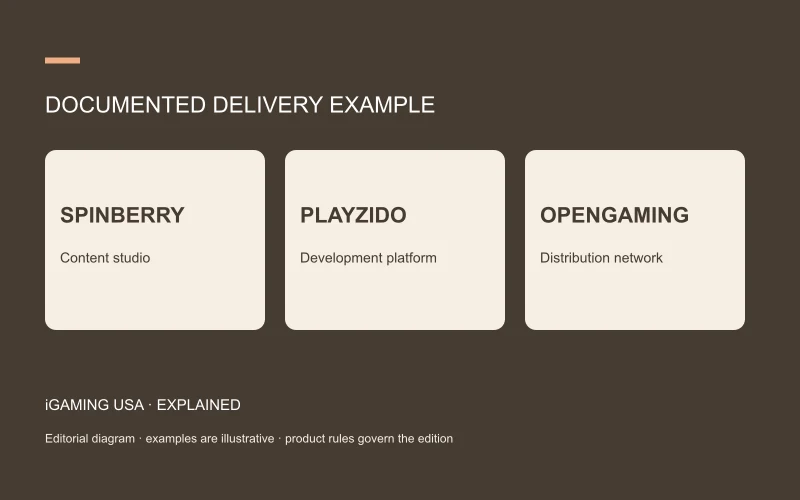
In its 3 February 2023 announcement, Light & Wonder said Spinberry games would reach OpenGaming through Playzido. The release identifies Playzido as a platform acquired by Light & Wonder in 2022.
That provides a three-part chain: the studio creates content, the development and delivery platform supports bringing that content into the ecosystem, and the aggregation network connects it with operators. The current iGaming overview describes OpenGaming’s wider role in connecting studios and operators.
| Layer in the example | Named participant | Useful question |
|---|---|---|
| Content studio | Spinberry | Which games are involved? |
| Development and delivery platform | Playzido | Through which technology are they delivered? |
| Aggregation network | OpenGaming | Which operator connection carries the catalog? |
Why one game can have several company names
A game’s information panel may name its studio, while a launch release names the delivery partner and the operator. Each name identifies a different role. Mapping those roles gives readers a practical explanation of how the title reaches a lobby.
For an editorial worksheet, give each title one row with studio, product identifier, delivery platform, operator edition and source date. That record can be updated when the game reaches another operator or market. The title remains the anchor while its distribution records expand.
An illustrative catalog count
Suppose a hypothetical studio supplies eight titles through one platform connection. An operator enables five of them in a particular edition. The studio portfolio count is eight and that edition’s enabled count is five. Both numbers are useful when their scope is stated.
This example explains why a portfolio announcement and a live lobby can show different counts. A clear article labels the full supplied collection, the local offering and the date of observation. The count becomes a description of a defined catalog.
How to read the next partnership release
Extract the studio, delivery technology, aggregation network, market and launch stage. Use the exact source wording to identify whether the release documents an agreement or an available product. Then connect it to the relevant game or supplier overview.
What should a US reader take from the model?
It is a way to understand supplier roles. Availability for a specific state comes from the local product and its documented launch. Our platform and aggregator explanation supplies the terminology, while Bragg’s Fuze integration model shows how another supplier breaks a product into operational components.