Explainer
Revenue Share vs Flat Fee in iGaming: Compare the Full B2B Invoice
The short answer
Revenue share charges a percentage of a defined revenue base; a flat fee charges a stated amount for a defined service and period. A useful iGaming comparison also specifies setup costs, minimums, content, hosting, third-party services and the exact GGR or NGR definition.
In this article
A percentage and a monthly dollar amount can describe the same service in two different ways. They become comparable when the service scope, calculation base and extra charges are placed on the same page. That is the useful starting point for revenue share versus flat fee in iGaming.
Real supplier disclosures show why the full invoice matters. Evolution's 2025 annual report describes percentage commissions alongside monthly dedicated-table charges and setup fees. These are distinct components of a commercial relationship. Evolution Annual Report 2025, revenue model.
The calculations below use invented quotes for an imaginary service. They demonstrate invoice mechanics rather than reproduce a vendor's price list.
Define what each fee buys
A revenue-share fee is calculated by applying an agreed percentage to an agreed base. A flat monthly fee is a stated amount for the services included during that month. A hybrid fee combines a fixed amount with a variable component.
The base deserves equal attention to the rate. A contract may identify gross gaming revenue, a specific net gaming revenue definition or another clearly described measure. Our NGR formula and worked example shows how a deduction changes the number to which a percentage applies.
A service description should be equally concrete. “Platform” might refer to account services, hosting, reporting and selected integrations. Game content, payments or managed operations may have their own commercial lines. Naming those components makes two proposals easier to compare.
Three monthly models with the same assumed scope
Suppose three fictional proposals cover an identical service bundle:
- Percentage model: 20% of defined monthly NGR.
- Fixed model: $7,500 per month.
- Hybrid model: $3,000 per month plus 10% of defined monthly NGR.
All three use the same currency, period and service scope. We assume the examples have zero setup costs and zero additional pass-through charges for this first comparison.
| Assumed monthly NGR | 20% revenue share | $7,500 fixed fee | $3,000 + 10% hybrid |
|---|---|---|---|
| $10,000 | $2,000 | $7,500 | $4,000 |
| $30,000 | $6,000 | $7,500 | $6,000 |
| $60,000 | $12,000 | $7,500 | $9,000 |
At $30,000 NGR, for example, the percentage calculation is $30,000 × 20% = $6,000. The hybrid calculation is $3,000 + ($30,000 × 10%) = $6,000.
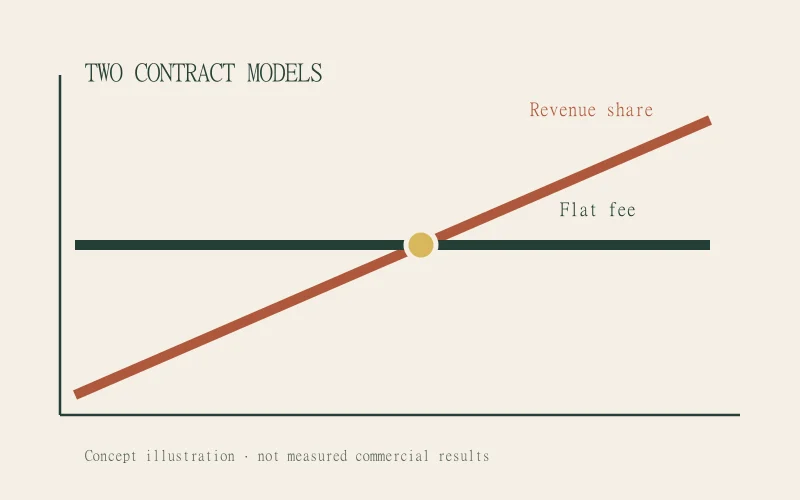
The table makes the fee behavior visible. The fixed amount stays constant within the assumed scope. The percentage component moves with the defined revenue base. The hybrid combines both shapes.
Calculate the fee crossover, then add other lines
For the first two sample proposals, the fees are equal when:
20% × NGR = $7,500
NGR = $7,500 ÷ 0.20 = $37,500
This is the crossover of those two fee formulas. It is an invoice comparison under the stated assumptions.
Now make the fixed proposal more detailed. Imagine it also has a $12,000 setup charge and $1,400 of separately specified monthly services. If a planning worksheet spreads that setup amount over twelve months, it adds $1,000 per month for the comparison.
| Planning line | Monthly comparison amount |
|---|---|
| Fixed service fee | $7,500 |
| Specified additional services | $1,400 |
| Setup allocation: $12,000 ÷ 12 | $1,000 |
| Total planning amount | $9,900 |
On that expanded basis, the comparison with a 20% fee reaches $9,900 at $49,500 NGR. The changed scope explains the changed crossover. A clear proposal therefore states both the headline fee and the included components.
Keep software pricing and referral pricing distinct
The same commercial words appear in affiliate marketing. Gambling.com Group's 2025 filing describes CPA, revenue share and hybrid referral arrangements. These concern compensation for referred customers, with NGR used in the revenue-share model. 2025 Form 20-F.
A fixed software subscription and a CPA payment answer different questions. One pays for a defined service period; the other is tied to a defined acquisition event. Keeping the trigger beside the fee makes the terminology precise.
For a software comparison, prepare one row per component:
| Component | Useful detail to specify |
|---|---|
| Account platform | Included functions and brands |
| Hosting and support | Environment, hours and service scope |
| Content | Named suppliers and calculation base |
| Integrations | Setup work and ongoing services |
| Reporting | Included reports and delivery |
| Commercial settlement | Currency, period, deductions and payment timing |
Our platform, RGS and aggregator guide explains the technical roles behind several of these rows. The gaming laboratory guide covers the separate documentary work associated with technical assessment.
Before comparing the formulas, align the starting measure using handle and revenue terminology and choose one shared reporting period. These two inputs keep the proposals on the same calculation basis.
Frequently asked questions
What does revenue share mean in an iGaming contract?
It means an agreed percentage of a defined revenue base. The contract's formula identifies the relevant product, period and adjustments.
What does a flat fee cover?
Its scope comes from the service schedule. A useful quote names the included functions and separately prices setup work, content or other services where applicable.
Can one agreement combine both models?
Yes. The sample hybrid formula combines a fixed monthly amount and a percentage. Evolution's disclosure also illustrates that a real supplier relationship can contain several fee categories.
What should a comparison worksheet contain?
Use the same revenue assumptions, service scope and period for each proposal. Then show the complete arithmetic, including any defined minimums, setup allocation and additional services. That gives the commercial discussion a concrete, reviewable basis.