Explainer
Net Gaming Revenue Explained: NGR Formula and a Worked Example

The short answer
Net gaming revenue, or NGR, starts with gross gaming revenue and applies the deductions defined for that business or contract, such as bonuses, taxes and transaction fees. A clear NGR calculation states the starting figure, each deduction, the reporting period and the resulting amount.
In this article
Net gaming revenue is easiest to understand as a defined calculation, with a visible starting figure and visible deductions. The useful question is: “NGR under which definition?” Once that is answered, the arithmetic can be straightforward.
Gambling.com Group's 2025 annual filing describes NGR as gross gaming revenue adjusted for items such as bonuses, taxes and fees. That is a concrete company example of the term's use in industry agreements. 2025 Form 20-F.
The following calculation uses invented dollar amounts and an explicitly chosen contract definition. It is designed to make every step reproducible.
The NGR formula and its starting point
For this example:
Gross gaming revenue = settled stakes − player payouts
Contract NGR = gross gaming revenue − the contract's specified deductions
The first line calculates the gaming result for the defined settled activity. The second applies the commercial definition being illustrated. Labeling those two stages separately makes the relationship easy to follow.
Now establish the boundaries of the example. We use one fictional operator, one product, one calendar month, US dollars and settled activity from that month. The assumed contract allows three deduction categories: promotional credits, a defined tax allocation and transaction fees.
These boundaries matter because a total needs an identifiable scope. A reader can then compare the calculated number with the underlying ledger and understand exactly which activity it describes. Our handle versus revenue guide provides additional context for the starting terms.
A fully worked $1 million example
Suppose the fictional monthly ledger contains the following amounts:
| Calculation stage | Amount | Running total |
|---|---|---|
| Settled stakes | $1,000,000 | $1,000,000 |
| Subtract player payouts | $950,000 | $50,000 GGR |
| Subtract specified promotional credits | $8,000 | $42,000 |
| Subtract the contract's tax allocation | $10,000 | $32,000 |
| Subtract specified transaction fees | $2,000 | $30,000 NGR |
The arithmetic is:
$1,000,000 − $950,000 = $50,000 GGR
$50,000 − $8,000 − $10,000 − $2,000 = $30,000 NGR
Every deduction is an assumption of this invented agreement. The $10,000 line is a chosen example amount, with its treatment expressly included in the sample definition.
Two simple ratios add context. GGR is 5% of settled stakes: $50,000 ÷ $1,000,000. This sample NGR is 60% of GGR: $30,000 ÷ $50,000. Each percentage has a different denominator, so both the label and denominator belong beside the result.
Why two agreements can produce different NGR
Keep the same underlying stakes, payouts, promotional credits and transaction fees. Now compare two expressly invented definitions.
| Assumed contract definition | Calculation | NGR |
|---|---|---|
| Definition A includes the $10,000 tax allocation | $50,000 − $8,000 − $10,000 − $2,000 | $30,000 |
| Definition B uses promotions and transaction fees | $50,000 − $8,000 − $2,000 | $40,000 |
The activity is identical. The contractual calculation base changes by $10,000 because the specified deductions differ.
If an illustrative supplier agreement charges 20% of that base, Definition A produces $6,000 and Definition B produces $8,000. The percentage is the same; the defined base explains the different invoice.
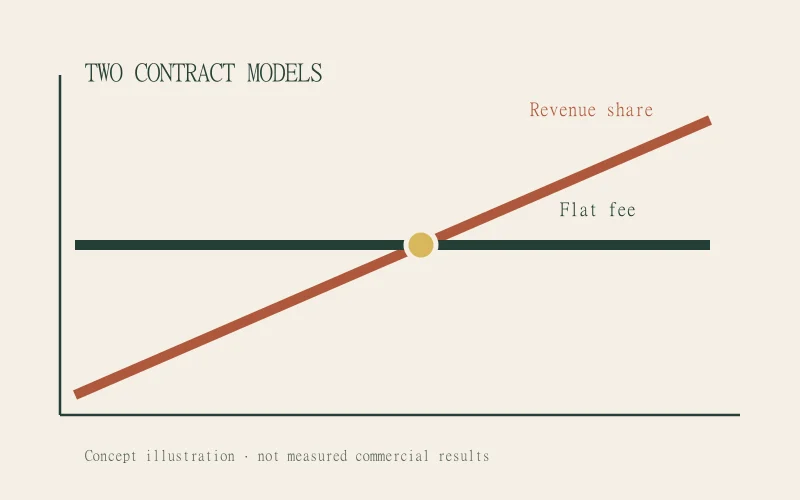
That is why a commercial term sheet should state the formula as well as the percentage. Our revenue share versus flat fee comparison develops the invoice calculation through several monthly-volume scenarios.
Put the number in its reporting context
A regulator's reporting measure has its own definition. Michigan's official commercial internet gaming tax instructions describe adjusted gross receipts through a statutory free-play deduction framework, including operator-year information. The forms directory separates commercial tax forms from tribal payment forms.
For a useful analyst worksheet, preserve five fields together:
- Measure: contract NGR, company-reported revenue or a named regulatory measure.
- Scope: operator, product and jurisdiction.
- Period: beginning and ending dates.
- Formula: starting figure and each included adjustment.
- Unit: dollars, thousands of dollars or another explicitly named unit.
For our sample, the final entry would read: “Contract NGR, Example Operator, Example Casino product, one calendar month, USD, $30,000 under Definition A.” A second sheet can retain the individual calculation lines.
This creates a transparent bridge between a reported headline and the underlying arithmetic. The reporting-period guide adds context for comparing calendar months, fiscal years and cumulative totals.
Our US gaming data context guide adds a broader framework for matching a measure to its reporting institution and product scope.
Frequently asked questions
What does NGR stand for?
It stands for net gaming revenue. Its practical meaning comes from the formula used by the company, agreement or report being read.
What is the difference between GGR and NGR?
In the worked example, GGR is settled stakes minus payouts. NGR then applies the sample contract's explicitly listed deductions. The calculation shows both figures separately.
Is NGR the same as operating profit?
Operating profit includes the business's applicable operating expenses under its financial reporting framework. NGR is the defined gaming-revenue calculation used in the relevant context.
What makes an NGR figure useful?
A stated period, product scope, unit and complete reconciliation make the number understandable. Those details allow another reader to repeat the calculation and compare it with the same definition in another period.