Explainer
Evolution Dream Creator: What a Custom Slot Project Includes
The short answer
Evolution Dream Creator is presented as a way for customers to design a custom online slot using established mechanics. The supplier names visuals, symbols, sound and bonus features as elements that can be shaped around a brand. A useful project brief separates those creative choices from the game specification and delivery requirements.
In this article
What Evolution Dream Creator describes
The official solutions overview positions Dream Creator as a customer tool for a customized slot. That is a distinct role within the supplier’s portfolio: it concerns the creation of a particular game experience rather than merely selecting an existing title from a catalog.
For an industry reader, the interesting distinction is between content identity and underlying mechanics. A project can change its visual world while preserving specified mechanical rules. The actual proposal should state which elements are selected, customized or separately developed.
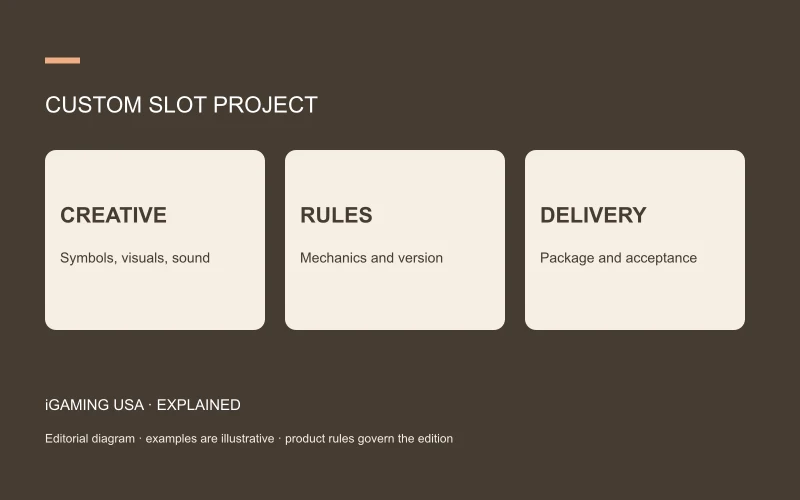
Build a brief around three documents
First, describe the creative concept: intended audience, tone, artwork, audio and symbol meanings. Second, describe the game: mechanics, configuration identifiers, rules and approved terminology. Third, describe delivery: supported devices, intended territories, acceptance process and responsibility for future updates.
Those documents give different teams a shared reference. An artist can check whether a symbol is legible at its smallest size; a product reviewer can check whether its role matches the help text; an integration team can check whether the delivered title matches the specified identifier.
| Workstream | A concrete deliverable |
|---|---|
| Creative | Approved symbol and sound inventory |
| Game specification | Named mechanics and configuration version |
| Interface | Screens showing rules, amounts and navigation |
| Delivery | Versioned package and acceptance record |
A symbol can have several design requirements
Consider a hypothetical branded compass symbol. The creative brief might define its shape and colors. The rules document would define whether it acts as an ordinary symbol, Wild or trigger. The interface review would check whether its role remains identifiable on a phone screen.
These are proposed design checks, rather than an account of a Dream Creator project we tested. They illustrate why a complete brief contains more than a mood board. Each choice needs a named reviewer and a concrete output that another team can understand.
Keep the edition and the artwork version identifiable
A practical handoff names the title, game identifier, rule version, artwork revision, supported language and release date. That lets an operator tell which package belongs in a particular deployment and which explanatory text belongs with it.
For example, a planning sheet with two artwork revisions and three languages describes six artwork-language combinations. It does not by itself establish six different mathematical games. Naming the counted entity makes release discussions much more precise.
What would establish a completed launch
A supplier product description establishes the offered capability. A completed project needs evidence of the agreed package and acceptance; a live launch needs evidence of deployment in a named market or operator catalog. These stages form a useful timeline for reading future announcements about custom titles.
Readers can use the same approach for any bespoke game proposal: start with the creative objective, attach the mechanical specification and record the delivery evidence.
Quick questions
Does custom artwork establish new game mathematics? The project’s specification must identify the mechanics and configuration. Does the product page promise a particular US launch date? A dated project or deployment record would be needed for that statement.
For related context, read gaming-lab certification and software supply-chain roles.