Explainer
Konami Online Interactive: How Its RGS Delivers Games
The short answer
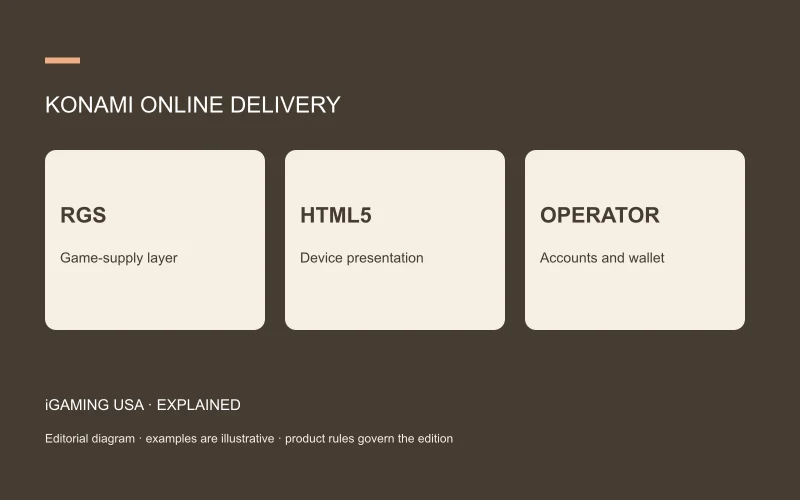
Konami Online Interactive delivers Konami game content through the company’s own remote gaming server, or RGS. Konami describes HTML5 delivery to phones, tablets and desktop devices. The RGS is the game-supply component; an operator still needs a defined account, wallet and customer-facing service around the content.
In this article
What Konami Online Interactive does
The official online-interactive page describes integration with operator backend systems and distribution to social and for-wager environments. Konami’s product directory also separates the online segment from physical cabinets and casino games.
That separation is useful when a familiar title appears in several formats. A title name connects the brand family; the edition’s own specification establishes its particular rules, presentation and operating environment. A cabinet specification and an online-game integration document answer different questions.
A round’s journey through the systems
An editorial model can trace five steps: a player opens a game, the operator authorizes the session, the game resolves a round, the wallet records the applicable transaction and the result becomes available for review. The exact interfaces and ownership of those steps belong in the supplier agreement and technical documentation.
For a buyer, the most useful diagram labels each identifier along that path. A session identifier, game identifier, round identifier and transaction identifier may all refer to related activity, while serving different purposes. A sample record that joins those fields shows how support and finance can discuss the same event precisely.
| Identifier | Useful review question |
|---|---|
| Game | Which edition and configuration was launched? |
| Session | Which authorized visit contained the round? |
| Round | Which game event is being reviewed? |
| Transaction | Which balance movement corresponds to that event? |
What HTML5 adds to the product discussion
Konami identifies browser-based delivery across device categories. For an operator reviewing a candidate integration, a practical acceptance set would include portrait and landscape presentation, readable game rules, account navigation and a consistent result history. These are proposed checks, rather than claims of testing performed for this article.
The same approach applies to performance: define the device, connection and measured operation before comparing times. A figure for initial loading and a figure for completing a game round measure different parts of the experience.
Social and for-wager distribution
The supplier describes both channels. Their account units and participation conditions need to be identified for the actual product being reviewed. A shared game theme does not supply the definition of the currency or the transaction model.
A useful catalog sheet therefore records title, edition, game identifier, channel, territory and date checked. That sheet makes an integration discussion concrete and avoids comparing entries that merely share similar names.
Quick questions
Does an RGS replace the operator’s entire platform? Its documented role is game delivery and integration; the proposal must assign the surrounding account and operational services. Where can I read more? The guide to software layers supplies the vocabulary, and gaming certification explains the evidence needed when reviewing a specific product version.