Explainer
IGT PlayDigital Engagement Platform: A Tool-by-Tool Guide
The short answer
IGT PlayDigital’s Engagement Platform is a collection of promotional and presentation tools around game content. Prize Engine, Missions, Leaderboards and Player Hub have distinct roles. Understanding that separation helps industry readers evaluate what an integration actually adds and what the underlying game continues to do.
In this article
The IGT PlayDigital Engagement Platform map
The official suite page lists Prize Engine, Leaderboards, Missions, Prize Draw, MEGA VAULT, Free Rounds and Player Hub. IGT’s broader PlayDigital overview places engagement services alongside content and progressive products.
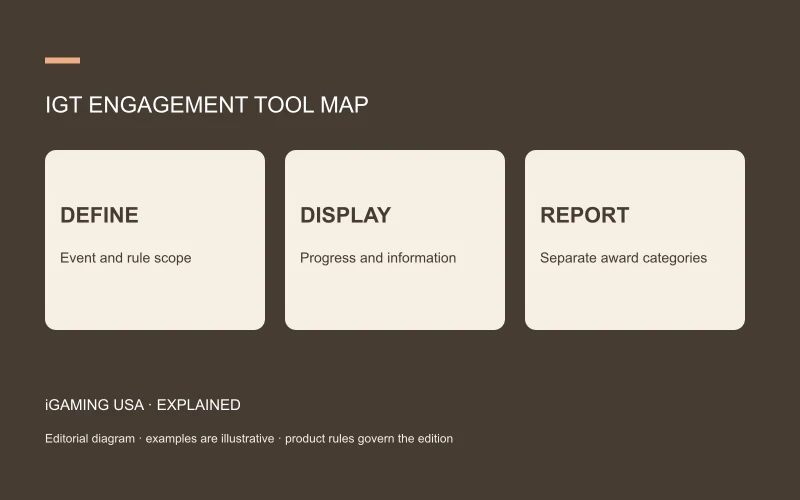
For an industry comparison, organize the tools by their function: defining an event, recording progress, distributing an award and displaying information. That map is an editorial way to read the suite; the current implementation specification establishes which components a particular operator uses.
| Tool family | Question it helps answer |
|---|---|
| Missions | What condition and progress are defined? |
| Leaderboards | How is a published score organized? |
| Prize tools | How does a defined award event operate? |
| Player Hub | Where can the user read the relevant information? |
Why the game and the surrounding event need separate rules
A game has its own round mechanics and paytable. A surrounding event has a scope, period, eligibility conditions and award process. A useful product explanation keeps those documents identifiable so readers can understand which system produced a displayed amount.
Consider a hypothetical report with two columns: game-round awards and separately funded event awards. If those columns show $120 and $15, the combined credited amount is $135, while the game-round column remains $120. This example illustrates reporting categories only and makes no claim about a current promotion or its participation conditions.
What a clear implementation brief contains
Write down the named tool, supported territory, participating content, event dates, time zone, reporting fields and responsible support team. Include the rule version and where that version is shown to users. These details allow a reviewer to compare the proposed scope with the delivered behavior.
For a leaderboard display, for example, an acceptance brief could specify the score unit, period displayed and update timestamp. For a progress display, it could specify the current value and completion condition. Such checks measure clarity and faithful presentation; performance claims require their own properly defined evidence.
Reading commercial claims with useful units
The supplier presents the suite as a way to create engagement experiences. To assess an outcome, define the metric, population and time period before comparing figures. A count of displayed interactions, a count of unique users and a cash award total describe different things.
A hypothetical comparison of 1,000 and 1,200 completed events represents a 20% increase in that event count. Whether the same users, dates and content were included would still need to be established. The calculation alone does not establish a cause.
Quick questions
Is Player Hub a game engine? Its listed role is an in-game information hub. Does the suite page establish a live deployment at a specific US operator? A deployment announcement or operator evidence is needed for that claim.
For background, software supply-chain roles and NGR definitions help readers keep product and reporting terms consistent.