Explainer
High 5 Games Jackpots: Timed and Conventional Formats
The short answer
High 5 Games advertises both timed and conventional progressive jackpots under High 5 Jackpots. For an industry reader, the distinction to investigate is how the award event is defined. A time display, a growing pot and a participating game are separate pieces of information, each of which needs a clear rule and scope.
In this article
What High 5 Games publicly describes
The supplier’s current website identifies both jackpot formats. Its overview establishes the product categories, while an individual implementation’s rule sheet is needed for the exact clock behavior, contribution, participation and settlement conditions.
That gives a useful starting point for a product brief. Record the named jackpot format, the linked titles and the rule document that explains the event. A concise overview can then tell readers what is established and which details depend on the specific implementation.
Three numbers that can appear together
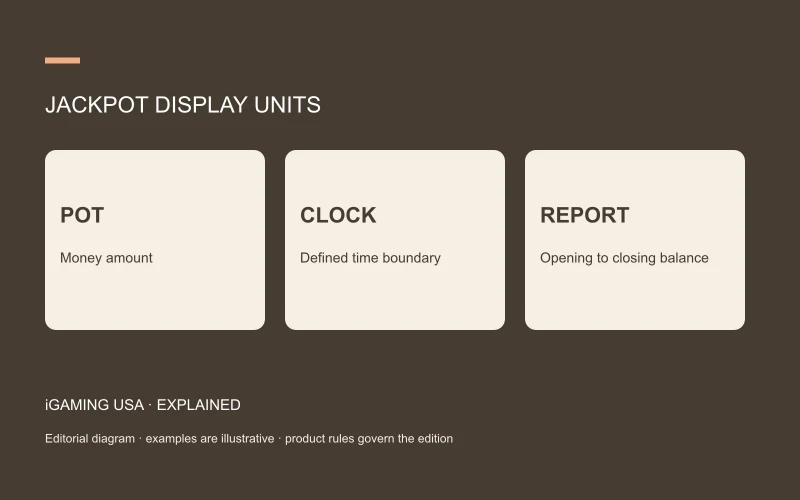
A pot display gives a monetary amount. A countdown gives time remaining to a defined event or boundary. A contribution rate, when specified, describes an allocation from its defined base. Each number has a unit and a rule that tells you how to interpret it.
| Display | Unit | Useful question |
|---|---|---|
| Pot | Dollars or another stated currency | Which named jackpot does it describe? |
| Countdown | Hours, minutes and seconds | What precisely happens at its endpoint? |
| Contribution | Percentage of a defined base | Which activity and period are included? |
| Last award | Money plus timestamp | Which completed event does it record? |
This table is an editorial reading aid, not a reproduction of every High 5 implementation. It makes a supplier demonstration easier to discuss because the participants can point to the same unit.
A worked timing example
Suppose a hypothetical interface shows an event endpoint at 18:00 Eastern Time and an observation at 16:30 in that same zone. The displayed interval is ninety minutes. The event rules would still need to state what that endpoint means: a scheduled action, a boundary or another defined event.
For reporting, keep the date and time zone beside the clock time. An endpoint copied as “18:00” without those fields is an incomplete record, especially when teams operate in different regions or across daylight-saving changes.
A worked contribution example
If an illustrative schedule allocates 0.5% of $2,000 of eligible activity, the allocation is $10. The named base and eligibility definition make that calculation reproducible. The amount displayed in a pot may also reflect its seed, prior allocations and completed awards, according to the actual product rules.
For a B2B comparison, ask for a sample report showing the opening value, additions, awards and closing value. That structure allows a reviewer to reconcile the record without using a marketing headline as an accounting definition.
What would verify a specific deployment
A supplier overview establishes a capability. A named operator announcement, participating-title list and current rule version establish a particular deployment’s scope. This article explains the labels visible in the supplier overview and does not claim a current jackpot amount or state-specific operator offering.
For related reading, gaming product certification explains version-specific evidence, and software layers places jackpot services within a wider integration.