Explainer
Jackpot Royale vs Express: White Hat’s Two Jackpot Layers
The short answer
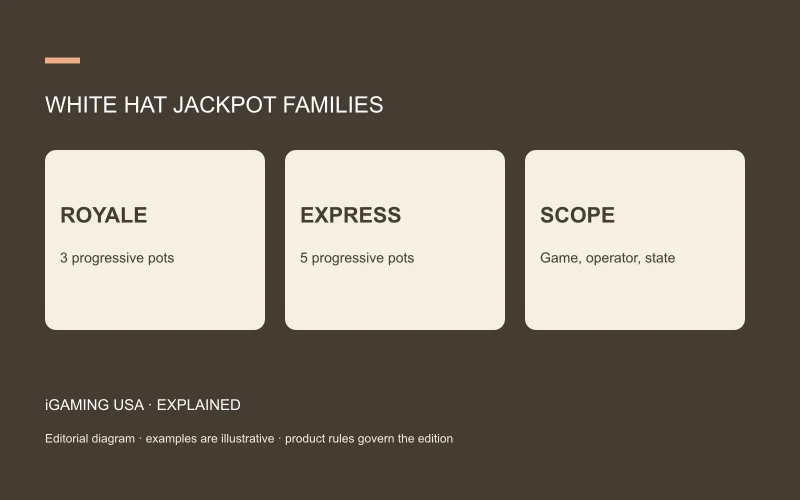
White Hat Studios distinguishes Jackpot Royale, with three progressive jackpots, from Jackpot Royale Express, with five. Both are jackpot products that can connect to participating games. The useful comparison starts with the jackpot layer, then checks the particular game’s entry mechanics and the operator-and-state configuration.
In this article
Jackpot Royale versus Express
The official product page identifies three progressive jackpots in the original Royale and five in Express. The supplier’s Amplify Jackpots overview presents them as separate layers with different intended reward rhythms.
Those product descriptions explain the families. A specific game’s rules establish its trigger, award sequence, contribution and eligible configuration. Keeping family and edition separate is particularly useful when the same theme appears with a jackpot suffix added to its title.
| Comparison field | What to record |
|---|---|
| Product family | Royale or Royale Express |
| Number of pots | Three or five in the referenced product description |
| Participating title | Complete title and edition |
| Pool scope | Named operator and state configuration |
| Entry rules | The title’s actual trigger and award sequence |
The jackpot layer and the base game
A linked title can have ordinary game awards and a separate jackpot mechanism. For a clear review, identify which counter belongs to the base game, which belongs to a feature and which displays a progressive pot. Each can appear on the same screen while describing a different part of the product.
Imagine a hypothetical report with $8 in ordinary round awards and a separately identified $25 feature award. Their total would be $33. A progressive pot displayed elsewhere on the interface is another value, whose payout conditions come from its own rules. The example illustrates categories rather than any live prize.
How to read a contribution percentage
Where a product schedule identifies a contribution rate, the percentage needs a defined base. An illustrative 1% rate applied to $500 of eligible wagers represents $5 of contribution. That arithmetic establishes the amount allocated under the example’s assumptions; it does not identify who receives a jackpot or when it is awarded.
A good commercial comparison therefore keeps contribution, ordinary game return, supplier fees and promotional funding on separate lines. Their definitions determine whether they can be combined for the particular reporting purpose.
What a useful launch announcement includes
Look for the operator, state, participating titles, product family and live date. A library announcement may introduce the general product; a deployment announcement establishes a particular implementation. For readers following the US market, state and operator scope are especially useful pieces of context.
The supplier describes Express as oriented toward more frequent, smaller awards relative to its flagship layer. Treat that as product positioning. A measured frequency claim for a deployment would need its own clearly defined dataset.
Quick questions
Are the three and five pots the same thing as reel rows? They describe jackpot tiers. Can a displayed pot value identify its trigger probability? The current game and jackpot rules supply the relevant conditions.
For background, gaming certification explains version evidence, and NGR helps distinguish commercial reporting units.